


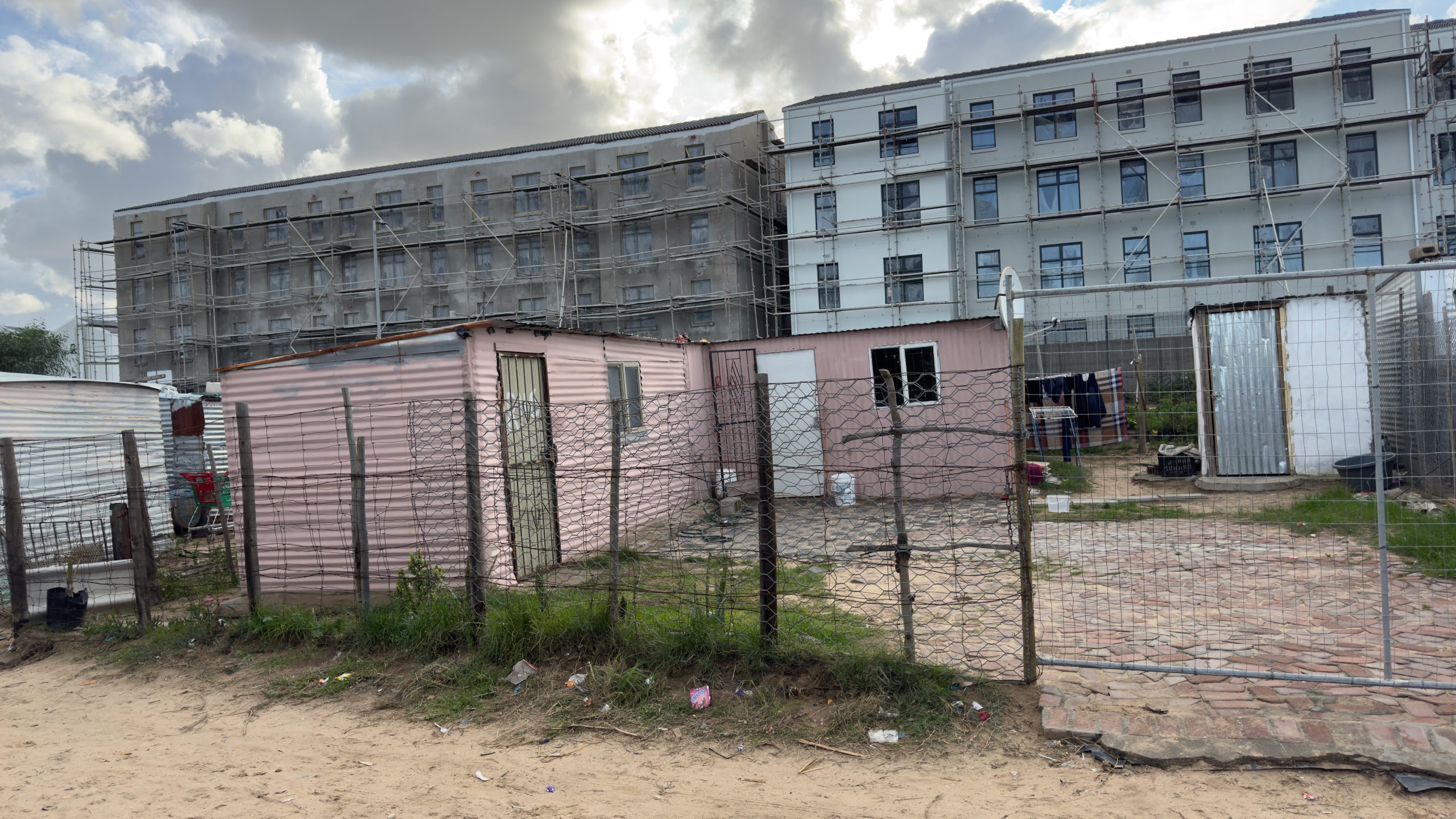
Residents endure raw sewage and lack of services amid delayed City action
Peter Luhanga
- Raw sewage from wealthy Pioneer Valley spills into Riverside’s informal settlement yards.
- The informal settlement was established on City land during Covid 19 lockdown almost five years ago, but no services have been provided.
- Law enforcers monitor the area with drones and prevent shack repairs while families suffer cold and rain.
At the edge of the manicured pavements and duplex homes of Pioneer Valley estate in Parklands North, fetid sewage has been flowing down the slope toward the Riverside informal settlement — also known as Erf 79 — near Dunoon for the past eight months.
Residents say raw sewage from a manhole just outside the wire fence marking Pioneer Valley estate’s boundary has been spilling onto their streets. Meanwhile, the Riverside informal settlement residents have no toilets and have to defecate in the bushes. They have is no potable water, no electricity, and no formal refuse collection to the settlement which was established during the Covid-19 lockdown.
The City’s law enforcement flies drones to watch their every move, while foot patrols block attempts to patch leaking shack roofs battered by Cape Town’s winter storms. Requests to repair their homes are met with silence.
In March 2022, the City served notices to the people living on Erf 79 informing them of their intention to obtain an eviction order, after obtaining an earlier interdict aimed at halting further occupation of what is deemed environmentally sensitive land. Yet more than two years later, formal eviction proceedings under the Prevention of Illegal Eviction from and Unlawful Occupation of Land Act (PIE) have not materialised. The City claims it is still gathering information in order to proceed.
Sibusiso Phalera, 45, shares a one-room shack with his wife, four children and his sister in Riverside. He moved to the informal settlement in 2021 after leaving the banks of the Diep River in Zwezwe, where rising water levels had made life untenable.
“Living here is very difficult. We have no toilets, no water, no electricity. We’re forced to relieve ourselves in the bushes, and home owners and tenants in Pioneer Valley take pictures of us while we do,” said Phalera.
Community leader Mzwakhe Dlamini says they have repeatedly raised concerns about the lack of basic services, especially since the land is City owned. Dlamini says it should not be difficult for the municipality to provide temporary relief such as water and sanitation while it finalises the eviction process within the bounds of the law.
“We need lights. It’s dark. Our homes leak during winter, and when we try to repair them, law enforcement comes and tears them down even without any court order authorising such actions,” said Dlamini.
He said residents are prepared to relocate when evicted in accordance with the law, but until then, they deserve access to basic municipal services.
“We have been here for five years. They should have recognised us and provide us basic services as an informal settlement until they decide what they want to decide on us,” said community leader Alathe Mazwembe.
Mazwambe said City law enforcement repeatedly tears down residents’ shacks as they attempt repairs. She questioned who bears responsibility for the demolitions, saying officials carrying out these actions often come from the law enforcement department rather than the City’s anti-land invasion unit.
Residents also complained of law enforcement barging into their homes at any time. The sound of hammering repairs is met with surveillance and swift reprisal.
Residents say they are watched closely and photographed as they try to fix their homes.
“When our roofs leak, what else can we do? They tell us to seek authorisation, this one time they confiscated my zinc sheets and planks,” said community leader Thotyelwa Mqumbisa.
Many residents cultivate vegetables in their shack yards, taking advantage of the sizable plots available to them. Most are unemployed, and some rear poultry.
Mafokeng Mphafane, 40, lives in a one room shack. He grows spinach in his yard, selling bunches to neighbours for R10 each.
“I am happy living here,” said Mphafane.
Deputy mayor and mayco member for planning and spatial development, Eddie Andrews, confirmed the City intends to apply for an eviction order.
Andrews said when the initial court order was granted in 2022, there were 230 informal structures on the site. He said the City is currently assessing whether this number has increased since then.
“This land is unsuitable for habitation given that it is situated within a floodplain area. Occupying
the floodplain also poses a risk of flooding of adjacent and downstream properties.”
He said the City conducted “ongoing” surveillance of the settlement.
“The City is awaiting further information from line departments and this will be included in our application to the Western Cape High Court, once we commence with the formal eviction proceedings in terms of the Prevention of Illegal Eviction Act,” he said.