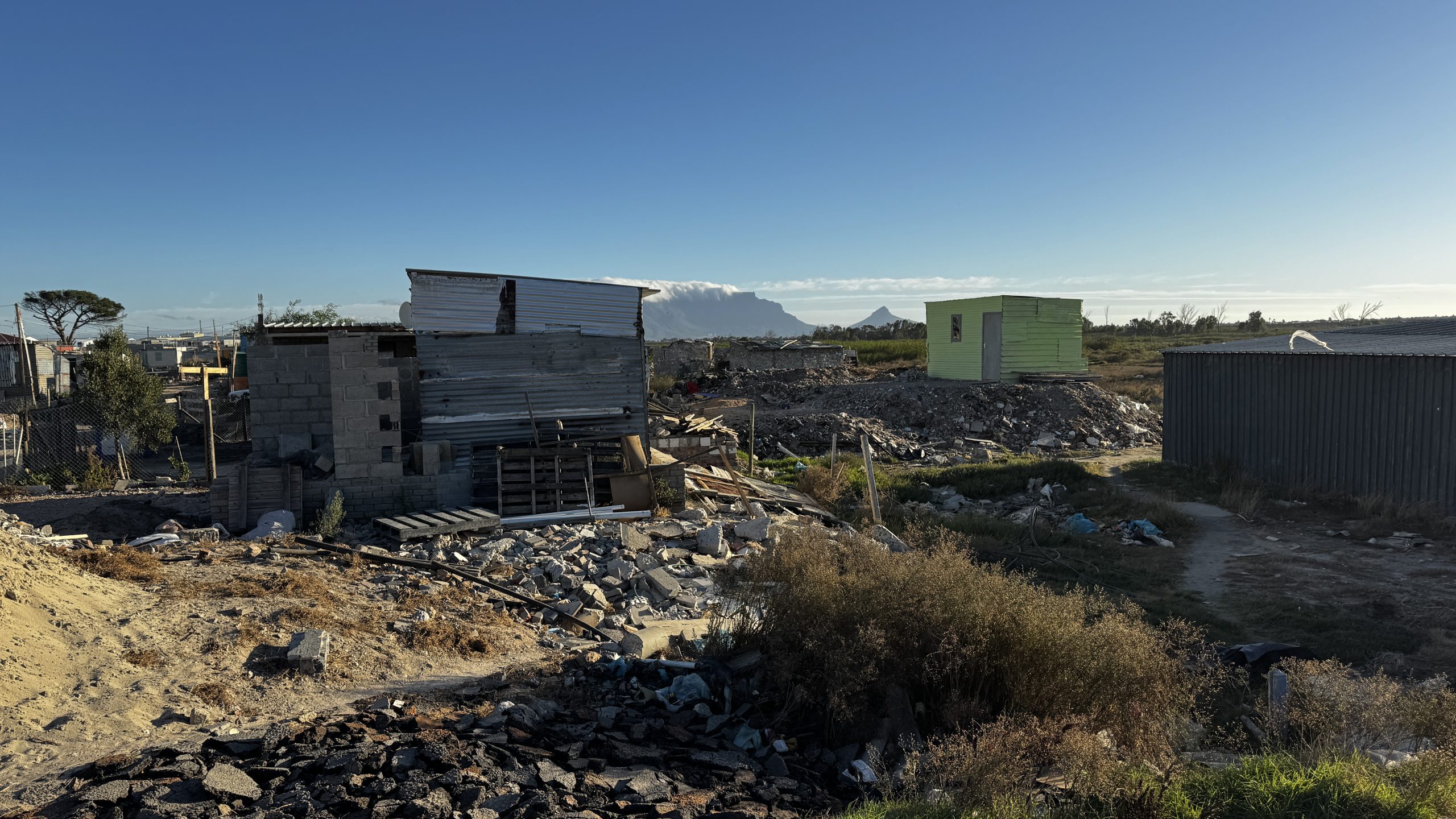
City says action is not an eviction, but was obtained to prevent people settling in an unsafe area
Peter Luhanga
- Court notice slapped onto shacks orders halt to building on floodplain.
- City says it is not an eviction, but a move to stop unsafe construction.
- More than 1,000 families have signed a petition in protest.
- But a Zwezwe informal settlement resident was fined R3,000 for unlawful occupation and ordered to appear in court.
Residents along the Diep River in Dunoon’s Zwezwe and Eluxolweni informal settlements are unsettled after legal notices were affixed to planks and structures along Malibongwe Drive on Thursday 19 March, warning against further construction on the floodplain.
The notice, labelled a draft order, bears a court stamp dated 3 March and refers to proceedings before the Western Cape High Court. It directs that construction of permanent and semi-permanent structures on erf 3844 along Malibongwe Drive cease, citing unlawful building on the floodplain. It states the order may be enforced by police.
The court documents name “unknown persons” as the first respondent, and the Milnerton police commander as second respondent.
Many residents took the notice to be an eviction. The City of Cape Town, responding to questions seeking clarity, said it was not. City spokesperson Luthando Tyhalibongo said the City had instructed its attorneys to pursue an interdict aimed at preventing unsafe construction along the riverbank.
“The City initiated legal proceedings for interdictory relief. The legal basis was the need to prevent unlawful and hazardous construction on the riverbank, which poses risks to public safety, health, and the environment,” said Tyhalibongo.
At the Eluxolweni informal settlement on Sunday, community leader Makhosi Manzi said more than 1,000 families had signed a petition opposing the notice.
Manzi said residents were seeking clarity on the scope of the land identified in the court documents, including where erf 3844 begins and ends.
“We went to the city’s attorneys on Thursday last week, we are challenging (the interdict). They must explain,” said Manzi.
After raising the ground on the Diep River floodplain with building rubble, Noluthando Zazini, 35, a security guard and mother of two, built a two-bedroom house using bricks and cement. The home, with an open-plan lounge and kitchen, is shared with her sister.
Zazini says she used R70,000 in savings accumulated over 12 months.
She is now building a brick boundary wall, saying that without one, washing left on the line is at risk of being stolen.
Before building in brick and cement, she says she lived in a three-room shack on the plot, which she purchased for R7,000 in 2021.
She says she began building her brick house in 2025 and completed it early this year.
However, the structure has already developed large cracks, including at the base above the foundations and around the windows.
She says building her own home brought a sense of relief after waiting 14 years for a housing subsidy. She questioned whether the City would compensate her for the money she had spent if the structure was demolished.
“It’s not comforting to hear about the interdict. I used my last money to build a brick house, money I saved for a year. I am trying to build my house on my own. If they demolish it, what will they provide? Will they pay expenses? What will happen?”
In the Zwezwe informal settlement near Malibongwe Drive, Mfaniseni Mhlabopalele, 54, said he built a one-room shack three months ago. On Saturday 21 March – Human Rights Day – law enforcement officers inspected structures in the area and issued him a R3,000 fine for unlawful occupation.
The written notice, issued under section 56 of the Criminal Procedure Act, lists a charge under the Unlawful Occupation By-Law. It directs him to appear at the Cape Town Municipal Court at the Strand Concourse on 1 July.
“They asked me why do I stay here. I said I stay here. I am unemployed and erected the shack three months ago,” said Mhlabopalele.
“This is abuse,” he said. “I am not feeling alright. I did not even go to church (on Sunday). I am depressed and shocked at the fine.”
His neighbour, Lwazi Mtyeku, who lives in the same yard, said Mhlabopalele had been living in the shack for three months. He said the fine was unjustified.
“Worse, it was on Human Rights Day. They treated him so bad,” said Mtyeku.
“I don’t even have money to go to court,” said Mhlabopalele.
Community leader Nandipha Matiwane said that on the same day, law enforcement tore down a shack belonging to a resident who had been living there and was repairing it ahead of winter.
Another community leader, Sarah Adonis, said the interdict has left residents confused, as the area covers several erven. Adonis said it is unclear where the erf named in the interdict starts and ends, and which homes or extensions could be targeted.
Asked whether the City has conducted or been provided with an assessment of the number of households affected, Tyhalibongo said no assessment of households affected has been conducted or provided to the City. He said the order relates to preventing further construction, not displacement of existing households.
He said the City is ensuring compliance with constitutional protections by avoiding unlawful eviction. He said the interdict is narrowly focused on halting unsafe construction, with the aim of preventing homelessness rather than causing it.
“The City will monitor enforcement of the interdict to ensure it is implemented lawfully, peacefully and without excessive force,” he said.