
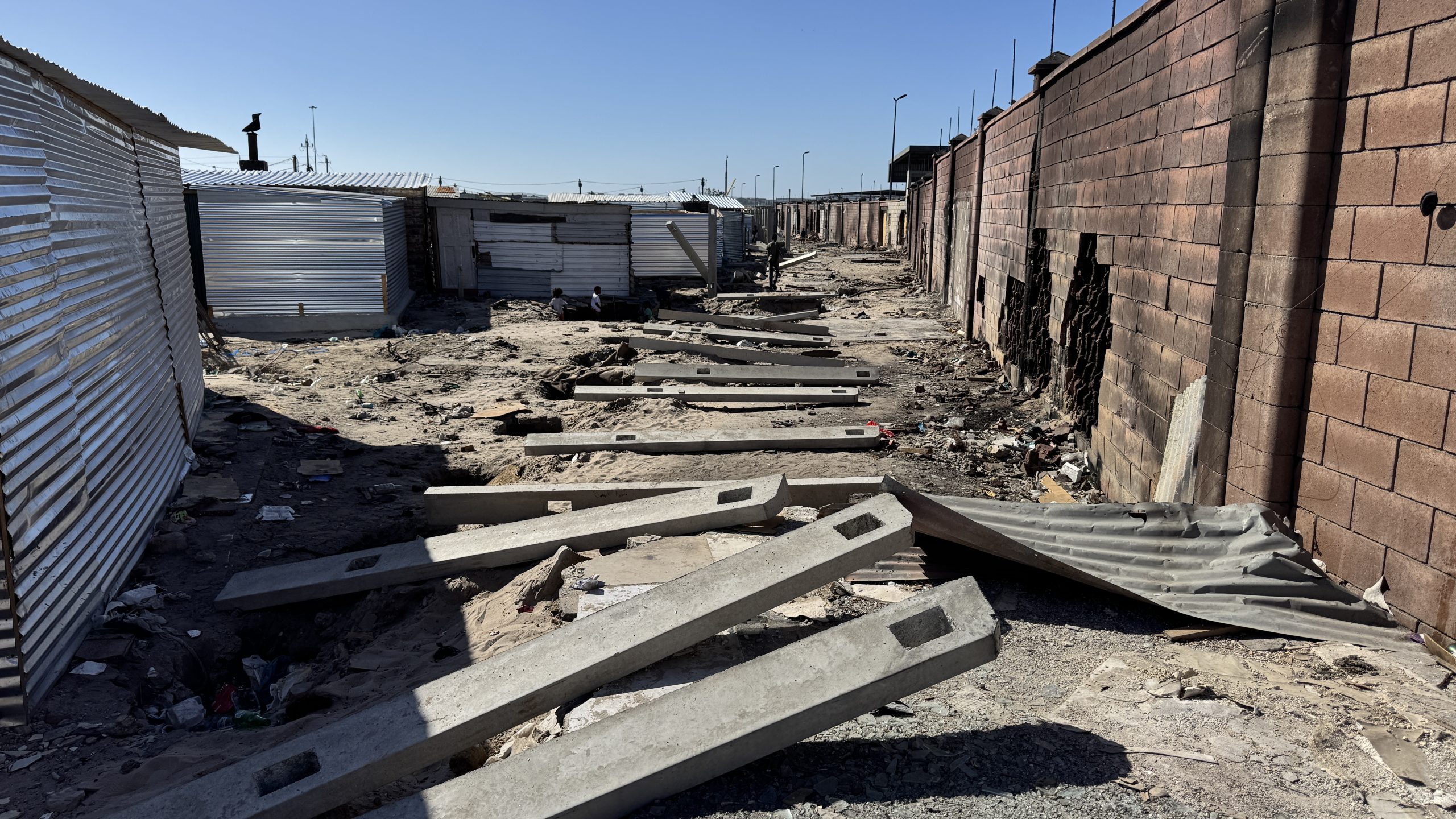
Boundary wall families still displaced and scattered after devastating shack fire
Peter Luhanga
- After a devastating shack fire on 9 January, 28 families have been prevented from rebuilding on their old informal settlement sites against a MyCiTi bus depot boundary wall.
- The National Department of Human Settlements proposed temporary accommodation at R450 per person per night, but this plan fell apart when the City baulked at providing transport and meals, citing national emergency housing regulations.
- The City has identified vacant land for just over 90 households and prioritised 23 families for relocation.
After a fire more than six weeks ago, 28 families from Doornbach informal settlement still have nowhere to live.
The families, totalling 114 people, who were among more than 2,600 residents who lost their homes in a fire on 9 January, had their homes built against the MyCiTi bus depot wall, and have been told they cannot rebuild on the sites they occupied.
Since then the families have been scattered. Some have sought refuge with relatives and friends, folding entire households into already overcrowded rooms. Others have rented single-room shacks in parts of Dunoon informal settlement. A few have moved into subdivided flats in extended RDP houses. In several cases, children have been sent to live with extended family while parents search for affordable shelter.
Nolubabalo Mgwedlanyana, 35, a mother of four, said the fire scattered her household. Her eldest child is 17, her youngest is four months old. She now rents a single-room shack in Thembeni informal settlement, living with her husband and infant while her older children have been sent to stay with relatives.
Mgwedlanyana said she survives on two child support grants, using the money to cover the R800 monthly rent.
Zikhona Masimini, 32, lost a four-room shack that housed her entire family. Since the fire, her family have been dispersed, some to Delft and others to Philippi.
Masimini now shares a single room with her cousin, paying R1,500 a month between them.
Even as families remain in limbo, national and municipal officials have traded positions over which sphere of government is responsible for their accommodation and support.
At the end of January, Tsekiso Machike, spokesperson for the Minister of Human Settlements, said the 28 affected families would be relocated and the department would fund emergency accommodation at R450 per person per night for 30 days.
Machike said two establishments had been secured to house the displaced households, and the City of Cape Town was asked to arrange transport to the facilities.
When transport arrangements could not be confirmed, he said the bookings were cancelled.
He said the Temporary Emergency Accommodation plan was reactivated on 15 February, with a renewed request for the City to provide daily transport and meals. The following day, displaced families declined the offer, citing the absence of firm commitments on transport and food provision. The department subsequently cancelled the accommodation.
He said responsibility would thereafter pass to the City, in line with its policy framework, to provide accommodation for the affected households.
The department stood to spend just over R1.5 million over 30 days to accommodate the 114 people from the 28 displaced families.
Asked why the department had chosen temporary hotel accommodation instead of securing land for permanent resettlement, Machike said providing Temporary Emergency Accommodation for disaster victims falls within his department’s mandate, while long-term resettlement and land acquisition rest with the Province and the City through the Informal Settlements Upgrading Partnership Grant.
After being presented with the national department’s account, mayco member for human settlements Carl Pophaim said Temporary Emergency Accommodation is the responsibility of the National Department under Directive EH 1 of 2023 and its guidelines.
Pophaim said the directive outlines the respective roles of national and municipal authorities and does not assign transport to the City. Any deviation from established policy frameworks, he said, could create compliance risks for the municipality.
He also said it was unreasonable for the national department to centralise the emergency housing grant while declining to arrange transport for residents it sought to accommodate.
He said the City remains prepared to perform the function, as it has in the past, if the grant is structured accordingly.
He further stated that scholar transport falls under the jurisdiction of the Western Cape Government, while the provision of meals is a function of Social Development.
In the absence of formal emergency accommodation, he said, displaced residents typically seek refuge with relatives and friends, and in some instances are assisted by non governmental organisations that secure temporary shelter in churches or privately owned halls while longer term arrangements are pursued.
Asked whether families removed from MyCiTi depot boundary wall would be permitted to return once the wall is rebuilt, he said it would be unsafe to allow reoccupation near the structure. A minimum six-metre buffer must be observed before any rebuilding could be considered.
He said the City has identified vacant land capable of accommodating just over 90 households. He said 23 affected families are being prioritised for relocation, with further opportunities being developed for residents willing to move away from the boundary area.
“This decision is obligatory on the City after the National Minister of HS [Human Settlement] commissioned the NHBRC [National Home Builders Registration Council] to undertake a review and made a legal determination,” said Pophaim.
On Monday, Subcouncil 1 manager Roxanne Moses led displaced families to inspect a site identified for their accommodation in Dunoon. City law enforcement officers in bulletproof vests were present during the visit.Moses said she had met the affected households on Saturday at the subcouncil offices in Paddocks, where the proposed arrangements were set out.