
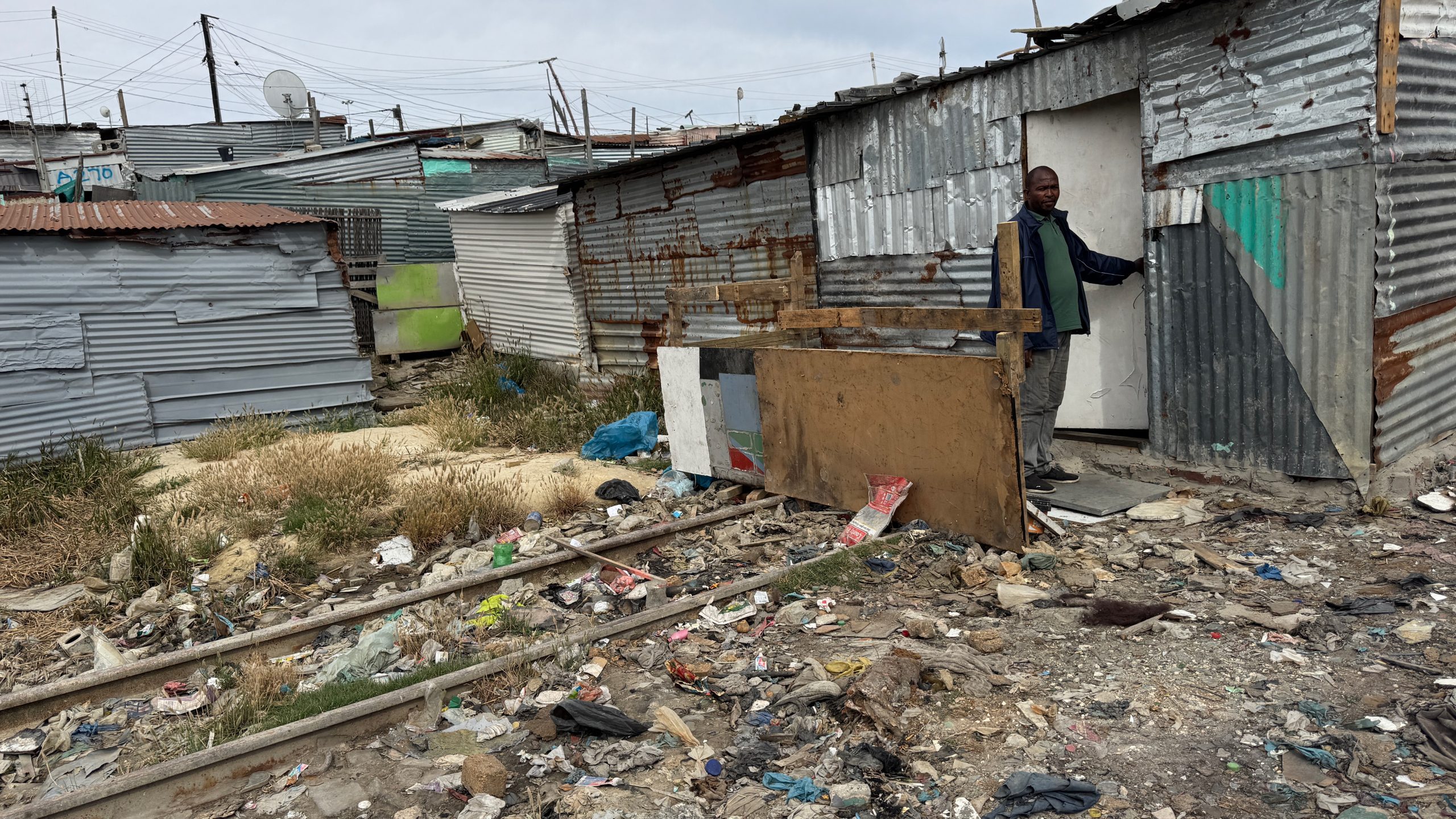
Some residents are putting in concrete foundations despite an uncertain future
Peter Luhanga
- A High Court-supervised relocation plan dating back to 2013 has not progressed.
- Settlement has expanded across and beyond live railway tracks, with permanent structures now being built.
- Families live with stagnant wastewater, no toilets, and limited water pressure.
- City says funding approval for relocation is still pending as numbers now far exceed the original count.
Residents of Siyahlala informal settlement in Dunoon were supposed to be relocated 12 years ago following a mediation agreement overseen by the High Court.
But nothing has happened, and the original 239 households that were part of the agreement with the City and Transnet, have grown far beyond that.
The settlement, once contained within the rail reserve, has now spread onto the tracks and further beyond.
New residents continue to arrive, driven by unemployment and rising rental costs in backyard shacks and rooms in extended RDP houses.
The community now waits in limbo. The rail tracks are buried. Siyahlala keeps growing.
No communal toilets have been installed along the railway. The nearest facilities remain at the former municipal sports field occupied in 2018, together with just three communal flush toilets in Mnandi Street. They are inadequate for the size of the settlement. Many residents use plastic bags or buckets and dispose of the waste along the railway where City contractors remove it daily and transport it weekly to landfill.
Between the shacks and the last fragments of railway sleepers, dark water sits in trenches filled with refuse. Plastic, clothing scraps, food waste and broken household items float in the pools. Tyres lie half submerged in mud as stepping points, although the ground beneath is saturated and unsteady.
Along the line the original railway infrastructure is being absorbed into the settlement, with shacks made from pallet boards and corrugated zinc.
Residents have begun laying concrete foundations, a shift from zinc toward permanence on ground previously marked for clearance.
A double storey shack is built directly on the rail track on the approach to Potsdam Bridge. Beneath the bridge more dwellings have been carved into the embankment where soil has been cut away to increase the amount of level space.
Community leader Zukiswa Kaphakati, who participated in the original mediation talks from 2008 to 2013, says many of the current Siyahlala households were not part of the original relocation list. Some lost jobs. Many arrived seeking work in the nearby industrial areas such as Winning Way Business Park and Killarney Gardens, the boundary of wall of which now borders the extended informal settlement.
No choice but uncertainty
Cameron Simana, 55, says last year he bought a shack built directly on the railway line for R8,000. The seller was a neighbour who had moved to Zwezwe, near Site 5 opposite Dunoon. At the time, Simana was nearing the end of a security guard contract with little chance of renewal.
He began saving what he could, knowing he would soon be without an income.
Last year he used those savings to buy the shack. He is now unemployed.
He says he had no alternative but to accept the conditions as they are. The ground floods with dark, stagnant water. At night the waterline rises and the damp makes people ill.
“The place is damp. It causes pneumonia,” says Simama.
With no toilets provided in Siyahlala, residents relieve themselves in buckets or plastic bags and dump the waste outside next to Simama’s shack.
He says this is common practice among residents, including community leaders, because there is no other option.
One of those leaders, Mamelo Leoto, works for a City contractor that cleans Siyahlala. She confirms that she also uses a bucket at night and empties it not far from Simama’s shack, then returns in uniform the next day to remove the same waste and store it in a shipping container for weekly removal.
“We do not have toilets here, and the water pressure in the taps is very low,” says Leoto.
A few metres from the line, pensioner Zanele Pondloti, 65, has built a shack along the boundary wall of the Killarney factories. She previously lived behind the RDP houses in Siyahlala where she owned a shack which she sold for R20,000. She bought a new shack in Ezihagwini informal settlement for R8,000 and kept the balance, but struggled there.
Roads were inaccessible, and earlier this year she lost her right leg to diabetes.
She now walks with a frame.
Pondloti has since returned to the railway line and cleared a space for herself where she has built a one-room shack.
“I arrived here in November. I was struggling in Ezihagwini informal settlement. Uber didn’t want to come there. Here it is better. When I need to go to the clinic I am lifted to the nearby road in Dunoon and get into an Uber to get to the clinic,” says Pondloti.
She says electricity also influenced her decision to move, as power in Ezihagwini was weak and she could not run a fridge or stove. Here, she says, the connection drawn from an Eskom pole in Dunoon is stronger. She can cook, refrigerate food, and keep her medication cold.
“I’d like if we are removed then get decent accommodation so I can be safe,” she said.
Relocation “still pending”
Although a relocation agreement was formalised in 2013, talks have continued, and Kaphakati says the last mediation meeting involving all parties took place last year.
A later attempt to count shacks was disrupted by disgruntled residents, bringing the process to a halt.
She says residents believe the relocation has stalled, and with sewage and wastewater flowing year-round from the Silverleaf Primary School vicinity and past Siyahlala shacks, many households are moving onto the railway line and further beyond in search of ground that remains dry.
Human settlements mayco member Carl Pophaim says the mediation process between the various stakeholders commenced “approximately in 2008”.
Currently, Pophaim says the City and Province’s application for funding for the relocation is still pending.
Once approved, he says the City will be able to proceed with relocating households to provincial land.
Asked, how many households were originally identified for relocation, and how many occupy the line today, he said initial assessments indicated around 48 structures in the area, “the most up to date number, however, still needs to be determined.”
“Some residents may have viewed this as an opportunity to be included in the relocation project. Transnet was made aware of the unlawful occupation of their property as early as 1999, but no measures were implemented to safeguard the land from further encroachment at the time. There was, and is currently no Service Level Agreement (SLA) or Memorandum of Agreement (MOA) between the City and Transnet that would authorise the City to undertake safeguarding measures on their behalf,” said Pophaim.
Also, he said the City treats all residents fairly and equitably and there is no policy that dictates different treatment based on when a person arrived in an informal settlement.
“The City is aware of the conditions in the area and understands the concerns raised. It is important to note that safeguarding the area falls under Transnet’s responsibility. The City will communicate on the relocation plans as soon as further progress has been made,” he said.
Water and sanitation mayco member Zahid Badroodien claimed there are 55 chemical toilets, 18 full flush toilets and 15 standpipes in Siyahlala, with 15 chemical toilets provided along the rail reserve.
Questions were also sent to Transnet but despite several follow up calls, there has been no response.
Retired Transnet Freight Rail spokesperson Mike Asefovitz in 2018 said the mediation process was under the supervision of a judge who had been mandated to oversee the entire process until completion.At the time, Asefovitz stated the City, Transnet and community leaders were close to concluding an agreement to relocate homes to an area known as the Sand Dune, which would be flattened for settlement.
