


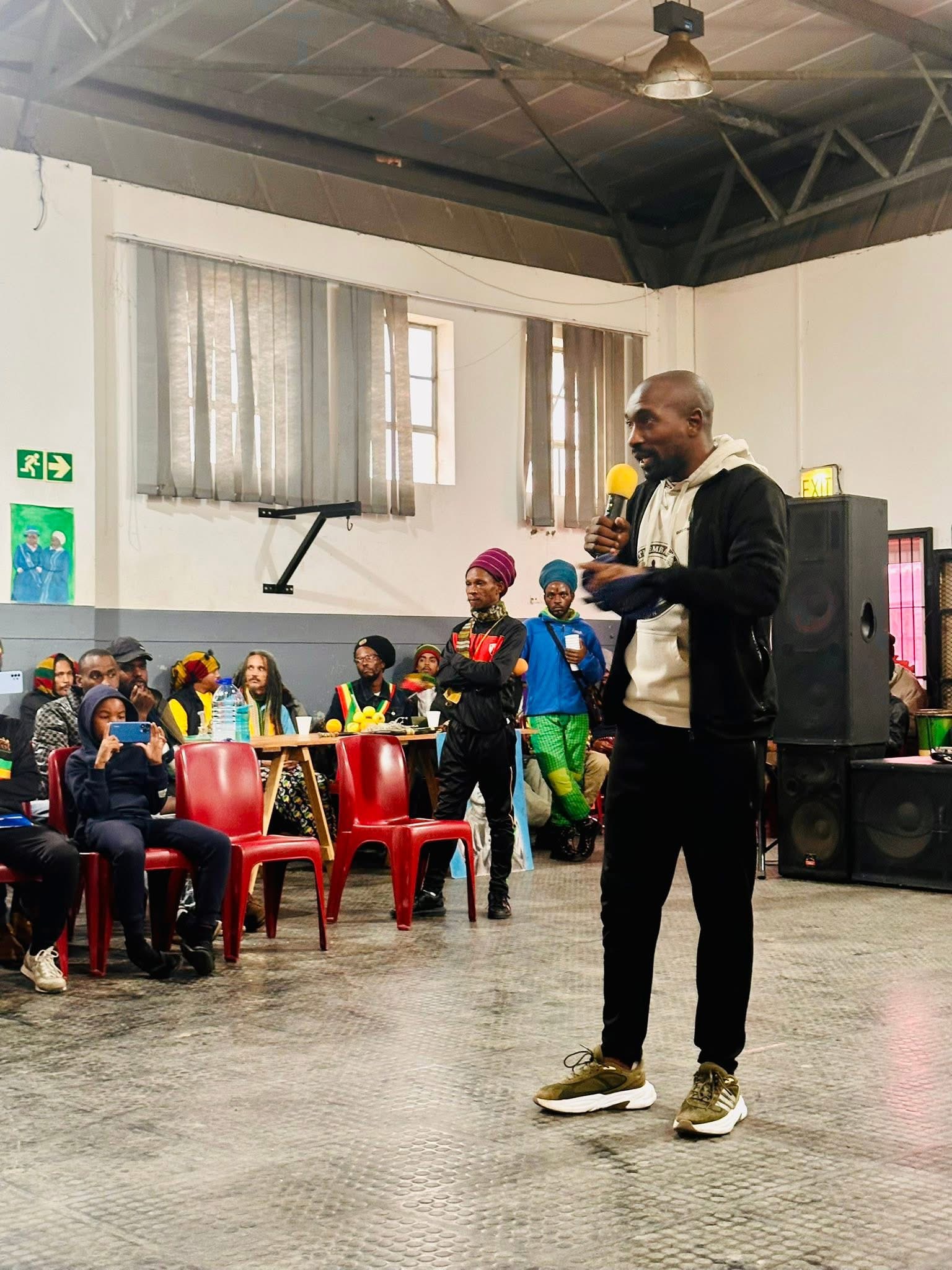
Former champion boxer Sinethemba Blom leads Youth Day celebrations in Dunoon as reggae and dance mark the ocassion
Peter Luhanga
Beneath a haze of dagga and Bob Marley’s rebel chords, the Rastafari community gathered in Dunoon on Monday 16 June, to mark Youth Day, honouring the children who were killed in the 1976 Soweto Uprising.
Youth Day commemorates the lives lost when schoolchildren rose against the apartheid regime, protesting the imposition of Afrikaans as the language of instruction at schools. The uprising ignited a national revolt that reverberated across the world and hastened apartheid’s unraveling.
In Dunoon’s packed municipal hall, reggae beats shook the walls as children’s voices rang out loud for Youth Day.
Performers from the West Coast, and Philippi’s Marcus Garvey township — an area often associated with crime and extortion — channelled the Rastafari spirit through Marley tributes, dance, and spoken word, turning the hall into a temple of memory and defiance.
Among them was Jabulani Trevor Hall, a 68-year-old Rastafari elder from Jamaica. He claims to have collaborated with Bob Marley, helped launch Lucky Dube’s freedom-reggae, and was with Peter Tosh in Swaziland in 1984. He also says he was banned from entering South Africa in 1985 as “a cultural activist”.
“I knew Peter Tosh. I worked with him. Even Bob Marley. Played percussion. When he [Bob Marley] was not with his band, he’d come to some of our Rasta celebrations where we would jam. I was with Peter Tosh in Swaziland in 1984,” he claimed.
While Hall’s interview was deeply compelling, independent verification of his claims regarding collaborations with Bob Marley and Peter Tosh could not be found.
He also claims to have worked with Brenda Fassie, who sang backing vocals for the band The Spank, and performed alongside African reggae icon Alpha Blondy. He said he later collaborated with the percussion ensemble Amampondo.
But in Dunoon, where hardship still shapes everyday life, the gathering was not merely retrospective. It was a cultural assertion. A celebration. A warning that the spirit of resistance still beats in time with the drums.
Outside the hall, elders sat cross-legged at the door, smoking pipes of dagga while children from community groups danced, clapped, and soaked in the chants.
Hall, a father of six, grandfather of eight, and great-grandfather of two — most of whom now live in Jamaica and the UK — rejects the name Trevor Hall, calling it a relic of enslavement. “It is not my forefather’s name,” he said. “It is the name my great-great-grandfather was branded with by slave masters.”
June 16, he said, holds deep personal meaning. As a young man living in the UK in 1976, he was part of a Pan-African youth movement known as Matta and Fancante. That year, inspired by the Soweto uprising, they occupied a building and established the first Black self-help centre in their community.
“A lot of that spirit came from what we witnessed in South Africa on June 16. Across the world, Black African youth were rising up. They thought we were part of the Black Panthers. That spirit of liberation has never left me. That is why I am here today, standing with the Rastafari community and supporting youth outreach where we live,” said Hall.
Inside the hall, the crowd erupted in cheers as he unleashed an impromptu reggae jam about June 16, proclaiming loud: “Education is a must.”
Rastafari elder Elphy Sibeko, known in the movement as Elfire Tsegaye, lives in the Marcus Garvey township in Philippi. A familiar face from South African television, Sibeko acted in the drama series Abakwazidenge and came to the event both as a community elder and a local celebrity aiming to inspire the youth. He was joined by six children from his neighbourhood, who sang struggle songs and powerfully re-enacted the moment police opened fire on protesting students in the 1976 uprising.
“The youth need to value education. The freedom they are enjoying today, people sacrificed for it. When you look at our Members of Parliament, most of them are over 60. We need leaders who will be coming from the youth, not the pensioners. We want the youth to take responsibility,” said Sibeko.
Celebrated lightweight boxer Sinethemba Blom, a former amateur stalwart and resident of Dunoon, played a key role in organising the Youth Day commemoration.
A two-time national university champion and four-time South African lightweight titleholder, Blom also clinched gold at the USSA National Championships and earned a first-round knockout at the South African Olympic trials, achievements that propelled him onto the 2018 Commonwealth Games squad.
Blom urged young people to stay in school and build future for themselves.
Dunoon community leader Bulelwa Mayende said the gathering was “about teaching and transferring knowledge … ensuring that the youth recognise the importance of their involvement in all community activities”.